Showing posts with label historic preservation. Show all posts

Thursday, May 31, 2012

LIGHTHOUSE

To gear up for summer, Architectural Digest is featuring a collection of pictures; "Great American Lighthouses" in its current issue. Growing up, we always visited lighthouses on family vacations, and I cannot see a picture of the Montauk Point Lighthouse without thinking of my dad, who used to spend his summers in Montauk. I would love to have the chance to visit all of the lighthouses on this list (and have seen a few!) but pictures will have to do for now. Here are a few of the featured pictures. Check out the slideshow on Architectural Digest's website for more (and more information!).

Montauk Point Lighthouse, Montauk, NY

Split Rock Lighthouse, Two Harbors, Minnesota
Thatcher Island Twin Lights, Rockport, MA
Cape Hatteras Light - in the Outer Banks, NC

Tuesday, April 24, 2012

HISTORIC HOME INSPIRATION - THE HOUSE OF SEVEN GABLES

The House of Seven Gables is located in Salem, MA and is open to the public as a museum. The property's website gives a brief history of the home, and its connection to Nathaniel Hawthorne.

The House of the Seven Gables was built by a Salem sea captain and merchant named John Turner in 1668 and occupied by three generations of the Turner family before being sold to Captain Samuel Ingersoll in 1782. An active captain during the Great Age of Sail, Ingersoll died at sea leaving the property to his daughter Susanna, a cousin of famed author Nathaniel Hawthorne. Hawthorne's visits to his cousin's home are credited with inspiring the setting and title of his 1851 novel The House of the Seven Gables. (www.7gables.org) 


Vintage postcards show the interior

Some inspiration...


Tuesday, April 10, 2012

HISTORIC HOME INSPIRATION: THE AMERICAN GOTHIC HOUSE

Also known as the Dibble House, the American Gothic House is the famous backdrop of Grant Wood's 1930 painting, American Gothic. Located in Eldon, Iowa, the house was listed on the National Register in 1974 and operates as a museum today.


The house is an example of an American vernacular style of architecture from the early 20th century: Carpenter Gothic. The style grew out of a need for quickly built homes and a desire for fanciful details. The price to add fanciful details to wood-framed structures decreased significantly so that even the humblest homes were able to incorporate some extra beauty. Identifying features of Carpenter Gothic include steeply-pitched roofs and gables, carved porch railings, strong vertical design elements, such as board and batten siding, and of course, pointed-arch windows. (American Gothic Website)


Some inspiration from the simple design of the American Gothic House:


Tuesday, April 3, 2012

NANTUCKET LIGHTSHIP


A sucker for anything nautical, I love lighthouses and boats. Combine the two? Awesome. When out on Long Wharf in Boston, you can sometimes spot the red ship across the harbor with bold, white letters spelling NANTUCKET on the side. I have always been curious about the ship, and was happy to learn about its history and that it is being preserved and utilized today. The ship has been refurbished and is now available for charters, rentals, and private events...how fun would it be to host an event on this ship? And as an added bonus, the proceeds are a way to sustain the life of the lightship for years to come. Here is a brief history, as listed on the official website, www.nantucketlightship.com.


The Nantucket Lightship wlv-612 was built in 1950 and was stationed three miles off of the Golden Gate Bridge as the San Francisco from 1950-1969. As Lightships were replaced with 40 foot unmanned buoys, the 612 next served off Cape Mendocino in California as the blunts reef from 1969-71 and in 1971 she went back through the Panama Canal to serve as the portland in Maine from 1971-75. Finally from 1975-1983, she served as the nantucket on the last Lightship station in the United States 45 miles southeast of Nantucket Island. In 1985, the Nantucket Lightship was decommissioned by the United States Coast Guard as the last Lightship in the United States. In 2000, Bill and Kristen Golden bought the ship on Ebay to preserve her, spent three years refurbishing the Ship and now offer the luxury yacht for charters, vacation rentals and events.


The mission of the Lightship was, a life saving mission, to stand resolute regardless of the peril and
guide all to safe haven. The first US Lightship was placed on station in 1820. In 1854, after hundreds
of shipwrecks, the United States Congress established the Nantucket South Shoals Lightship Station
to protect trans-Atlantic and coastal shipping from the dangers of the treacherous shoals. The wlv-


612 is one of a proud line of Nantucket Lightships which were known as the Guardian Angels of the
North Atlantic From 1854 to 1983, it was the Nantucket Lightship and not the Statue of Liberty which first greeted mariners and immigrants to America. Lightships serving this station were in international waters and were exposed to the dangers of fog bound collisions, enemy attacks and natural disaster from hurricanes and severe winter storms.


The Nantucket Lightship wlv-612 is one of a dozen lightships which remain. The others have all been
sunk or scrapped as artificial reefs. It is the objective of Bill and Kristen Golden to showcase the
Nantucket Lightship wlv-612 as a new model for historic marine preservation so that other ships may be saved for future generations.


Thursday, March 8, 2012

FENWAY

Fenway Park, which is celebrating its 100th anniversary this year, was placed on the National Register of Historic Places yesterday. Read about it here!

Friday, March 2, 2012

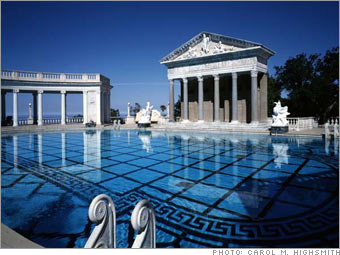
HISTORIC HOME INSPIRATION - HEARST CASTLE


Hearst Castle, located in San Simeon, CA, was commissioned by William Randolph Hearst, the son of a wealthy miner. In 1919 he hired Julia Morgan, a San Francisco architect, to help to build his dream home. The castle was completed in 1947, totaling 165 rooms with 127 acres of outdoor landscaping. (via www.hearstcastle.org) The estate is an amalgamation of architectural styles, but is commonly classified as Mediterranean revival.


Some everyday inspiration from Hearst Castle:


See all of the Historic Home Inspiration posts here!

Tuesday, February 28, 2012

DOORS OF DUBLIN

In 12 days I will be in Ireland (not that I'm counting...) and can't wait to explore Dublin, Killarney and Galway, with stops in Waterford and Cork! The trip will both start and end in Dublin, and one thing that I have on my to-do list is to see the colorful doors of Dublin, which were first featured on a tourism poster in the 70's, and many others since.


From some quick research, it seems that the factual origin of these colorful doors has been lost, but many different theories have survived. One believes that the doors were painted in protest to the Queen's death, when the British government declared that all doors should be painted black. My favorite theory is that the Irish wives painted their doors distinct colors, so that their husbands would stop stumbling into the wrong home after a few too many pints at the pub. Whatever the reason my be, I'm glad that the tradition has continued, and I look forward to taking my own collection of photos soon!


Thursday, February 23, 2012

HISTORIC HOME INSPIRATION - WILLIAM WATTS SHERMAN HOUSE

The William Watts Sherman House was designed by Henry Hobson Richardson, an American architect who famously designed Boston's Trinity Church along with Albany, NY's City Hall, the Marshall Field Wholesale Store in Chicago, and was a contributor to the design of the New York State Capitol.
The home became the prototype for a class of American architecture, the Shingle Style. Located in Newport, RI, the summer home was built from 1895-96 for William Watts Sherman, a wealthy banker from New York. It was acquired by Salve Regina University in 1982.


Inspired by Richardson's Shingle Style design:


Check out past Historic Home Inspiration entries here!